Heyo! I promised I'd post something more academic next time and I'm holding true to that. This is a topic I've covered three times now in my life, first time for a high school paper and second time for a student symposium last semester, but I CAN'T STOP because this is just such a fascinating niche to me and I want to nerd out about it to as many people as possible. In all likelihood I'll be revisiting it several more times, delving into specific composers and franchises to see how they handle it. For now, I'm just going to be retooling the symposium piece into a couple blog posts. No more shaking the bottle, let's twist the cap and get into it!
I'd like to start by asking a question: have you ever heard this tune?
This melody is called the Oriental Riff, and chances are it's crossed your path before. And if you're from America, England, France, Japan, or any other country steeped in Western music theory, it means one thing: China. For some it might more broadly represent Asia or the general idea of The East™, but at least for me these nine chords are enough to transport me straight to the Middle Kingdom with a cup of green tea in hand.
At least, to a fantasy version of it. Because that's what the Oriental Riff is: a fantasy. It's the frontman for a whole collection of tropes crafted by Western musicians to represent China in their work. And over the next three or so posts, I'm going to give a basic overview of where they came from and where they are now.
Chinoiserie and Cinesi - The China of Europe
To recount the entire history of Sino-European relations would take far more space (and research time) than I've got, so I'm going to be very breezy and begin in the mid-seventeenth century. This period marks the first widespread Western attempt to mimic Chinese art, sparked by the growth of direct trade with the Qing dynasty. Unlike prior centuries, when trade with China was accomplished through lengthy chains of middlemen and direct cultural contact was done mostly by Jesuit missionaries, better navigation and shifting legislation allowed more Europeans a firsthand, if still heavily restricted, peek into the country's culture and arts. And what they saw was equal parts inspiring and ungraspable.
Nothing more clearly illuminates this budding dual conception than the aesthetic which spawned in its wake: chinoiserie. Chinoiserie is a genre of psuedo-Chinese styled works based on European artists' approximations of what Eastern life was supposedly like. Its popularity stretched to the mediums of painting, pottery, textiles, and more.
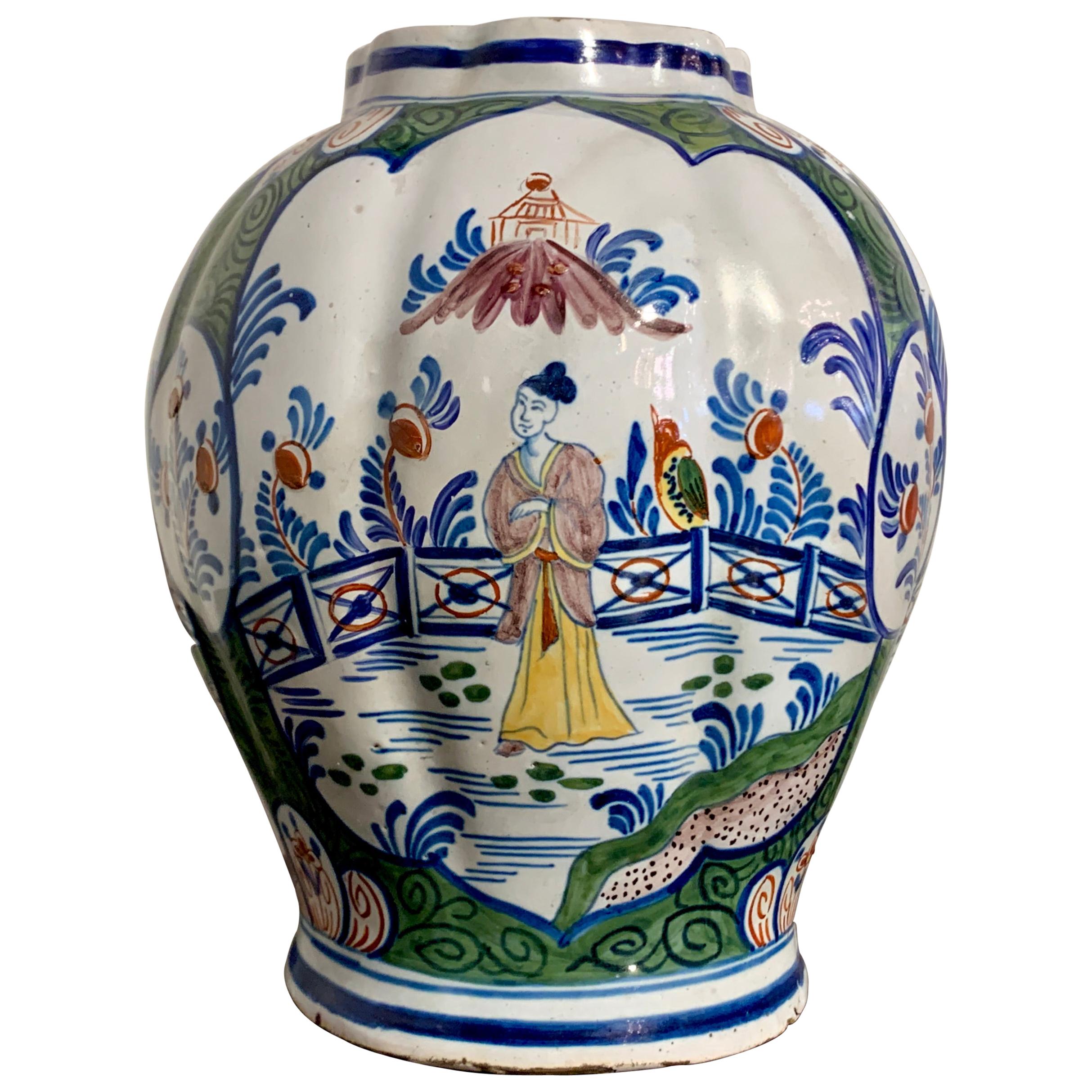
Encountering these pieces as a modern viewer, there's something deeply uncanny about them, at least to me. Not to say they're unpleasant, far from it, but everything from the blockily-colored pottery to the bathrobe-looking hanfu betrays an artist vaguely guessing at their muses in the absence of a full understanding. They're just... off.
But that vagueness, that off-ness is in some ways crucial to the aesthetic's ethos. To these artists, China was vague. It was a fairy tale kingdom with wishy-washy ideas of authority, a land of beautiful women, strange creatures, and many bizarre but harmless customs. Even if perfect information on Chinese life with all its bureaucracy and brutalities was available, its inclusion would muddle the mystique.
In his 2001 book, Ideographia: The Chinese Cipher in Early Modern Europe, professor David Porter characterizes chinoiserie as both a flattening and delegitimization of Chinese society, as a "delicious surrender to the unremitting exoticism of total illegibility." In simpler terms: China wasn't meant to be understood or taken seriously, but to simply look pretty.

Porter's book is interesting and slightly humorous to me, because reading it you get the sense that he really hates chinoiserie, in an almost insulted way. And he makes a convincing case that it was indeed insulting. By comparing early Western illustrations of Chinese court, where the emperor was surrounded by soldiers, to later ones, where he participates in ostentatious ground-level parties, he demonstrates the rapid decline in China's perceived authority and power. Personally, I can't help but wonder if some artists employed this delegitimization less as an insult and more for escapism's sake, as a gate into a world not governed by the strict protocols of upper-class European life. But the point stands that chinoiserie was a genre of fantasy, not historical realism.
As a brief final note before moving on, don't let it escape your notice that this defanging is deeply coupled with an infusion of femininity. The perception of the Chinese as hyper-feminine, along with the ever-pervasive tendency to pair femininity with weakness and insignificance, is going to come up a lot as we move forward.
Musical Chinoiserie
You might say - okay, that’s art. But what does this have to do with music? While chinoiserie was most prominent in the visual arts, there grew alongside it a smaller phenomenon of “musical chinoiserie”¹ among Western art composers², and it is here that our modern idea of Chinese-style music first begins to take shape. Like with painting and pottery, this music leaned hard into the perception of China as a mystical, near-utopian landscape, with customs Europeans couldn’t understand but could certainly enjoy imagining from afar.
Famed composer Claude Debussy was a rather prominent force in this genre, having drawn inspiration from various Asian sources (and secondhand European ones) in his work. The earliest of these works, an unpublished piece called Rondel Chinois, was based upon a French poem of the same name. The adapted lyrics fit right into the chinoiserie style outlined above, describing a beautiful Chinese garden, complete with a beautiful Chinese lady, in hazy snips of detail. Though he had never been to the country at that point, this description provided fertile enough ground for the active composer’s imagination.
On the other side of the art music coin from concerts were operas, which could employ lyrical, musical, and visual devices all at once to draw audiences into the creator's otherworldly vision of the Far East. Once such Opera was Cristoph Gluck’s 1754 Le Cinesi, which used the ostentation associated with Chinese nobility as a reference to and critique of the growing garishness of dress in the Western courts of Austria.

But that only describes the content of these works, the cultural connotations and extra-musical elements which gave them their meaning. What of their forms, the actual musical techniques which conveyed this “Chinese” flavor? In other words - how does this music sound, and why? To answer that question, one must first look at how early European analyses of native Chinese music were conducted..
One crucial early analysist was Joseph-Marie Amiot, a French Jesuit who worked as an intellectual intermediary between 18th century Europe and the Qing Dynasty and is widely regarded as the first European to supply public knowledge on the native music. In works like “Mémoire sur la musique des anciens” and “Mémoire de la musique des Chinois,” he provides his best analysis of Chinese musical systems, slotting them into the existing systems of Western music theory. According to ethnomusicologist Meredith Schweig, Amiot is the originator of the idea of a “Chinese Air,” a unified and largely homogenous sound essential to all music made within the country. He is also perhaps the earliest scholar to spread the idea that the Chinese primarily use a pentatonic, or five-note scale. This idea was expanded on by commentators on his work, such as music theorist Jean-Phillepe Ramaeu when he says “(they) want only five tones in their lü, which apparently means system, scale, or mode."
Analyses like these, grounded in the idea that there is some essentially “Chinese” sound which existed as a subset of existing Western musical ideas, set the precedent for how musicians create the new Chinese musical identity in their work. The first and most notable element of this new identity was a heavy use of pentatonicism, meaning a focus on the five-note scale Amiot and Van Aalst outlined above (you may recognize this as the black notes on a piano). Even today it remains perhaps the most prevalent and enduring device in this entire genre. Personally speaking, it seemed to be a common practice in my Southern childhood to sit and noodle on the black keys of the piano and claim (or have an adult claim for you) that you were playing “Asian music.” Take a listen to Debussy's Pagodes for a good early example of this device in action:
Parallel 4ths and 5ths, when a 4th or 5th interval is followed by another of that same interval, are another common trope. Both of these arise from those early analyses of Chinese music, but also in the perception of these intervals as foreign and unusual. Parallel 5ths especially are considered “incorrect” in Western harmony, directionless and mysterious just like a classic chinoiserie scene, so their inclusion is perfect to give a piece a non-Western feel.
Miscellaneous elements include repeated sixteenth notes. These repeated notes, especially in groups of 4, may have originated from composer’s attempts to replicate the perceived simplicity and noisiness of Chinese music, or the tremolo often used on traditional string instruments. An element with a similar origin is grace notes, small and short notes that accessorize a melody. These may have become popular as a way to emulate the “twanginess” of Chinese instruments such as the pipa, a Chinese lute.
Note that though these elements were present in European music, they were usually diluted by the local demands and traditions of Western music. It was later in America when these tropes would truly calcify, transforming from vague dreaminess to cartoonish specificity. And it's there they'd combine into that archetypical melody highlighted above: the Oriental Riff.
I'll be getting into that chapter next post! If this was at all interesting to you, please let me know so I know to work on the next part faster! Thanks for reading <3
1. Term coined by Angela Kang in her titular work.
2. "Art composer/music" here refer to upper-class genres of music which received the bulk of professional study, theory, and funding, as opposed to popular or folk music.
You can find my sources for this series here.

